Showing posts with label invest in yourself. Show all posts

Wednesday, April 29, 2015

The Shift (Part 2- Investing in new Opportunities)

The world must have felt my mental shift, because the day after my revelation while watching Merchant's of Doubt, I was invited and inspired by many opportunities that are in line with my new ambitions at the Sustainability Salon hosted by TedxAbq,

Leila Salim of ABQOldSchool invited me to DIY in a way I had participated in but hadn't identified- Do it Together. By taking on building challenges and craft projects with others, you not only have the potential to have more fun, you can get a lot more done and grow community. Her local organization boasts classes taught in traditional, frugal and sustainable living. She attributed her involvement in this share-space to her upbringing in the desert, similar to the desert that her Palestinian father had grown up in. She said that sharing is part of their culture in Palestine. While I recognize it’s not a routine part of mine, I’m making a point to change that, as you’ll read in a later blog. 
Her talk was hopeful, and totally in line with my goals. She even took an idea right out of my head: “What if in addition to libraries where you can check out books, there are places where you can take and return seeds, and sewing machines”. Her talk ended with a simple challenge—What can YOU offer to your community? What can you contribute? Yoga classes? Fresh-baked brownies? The service of fixing a broken toaster? Imagine if each one of us decided how we could contribute and then offered that, free of charge, to our community. Or had a more complicated Time Exchange system that revolves around the same idea.

Another local speaker, a woman I had worked with in other environmental capacities, spoke about her work on the Desert Teaching Garden—yet another place where I can build community and learn new skills. While describing the layout of the garden, she mentioned food forests- a phrase I’ve been hearing with increasing frequency. Just last night, in fact, while talking to a friend in school for landscape architecture, I was expressing my dreams that all parks be like the one I live in- abundant with edible trees (nuts, berries, fruits)—when he explained some of the work he’s doing, and some of the places around town that do have fruiting trees in their design. I said I’d be surprised if there isn’t a website for “crop mobbing” as he called it, where people can identify where and what is growing and then go collect it. (Indeed there is- check out FallingFruit.com) I have a feeling that in 10 or 20 years, we’ll be desperately relying on these crops, and seeing the atrocity of planting “ornamental” crops that are “messless” because they’re useless.  

Between speakers we watched a relevant Ted Video that I hope you all will watch, by Ron Finley. 


Finley had some great quotes about utilizing the space around him to grow food. 
“Gardening is my graffiti,” he admitted, adding later “growing yo’ own food’s like printin’ yo own $$!”
A few other opportunities that will prove to transform the numbers in my bank account into valid and wholesome life experiences are teaching and taking drum lessons (from my new favorite drummer!)
A fellow educator and very inspiring friend of mine mentioned that 2015 is the international Year of Soils. As an environmentalist, soil, just as climate, water and botany, greatly interests me. But because there are so many interconnected aspects of the environment, I have struggled with chosing a focus to learn more in depth. With UN's focus on soil and the resources offered, I can definitely learn more about this often overlooked area of critical importance, while teaching my students.

And finally, I acted on my birthday impulse to buy some drum lessons. I have been considering expanding my very minimal musical repertoire for months now, but it wasn’t until I learned that the drummer of my new favorite local band does lessons did I take action. Learning to drum may not help save the world, or seem very useful in a post-apocalyptic situation. But you never know until you try. And trying is the new theme of my year. 

Saturday, April 25, 2015

The Shift (part 1- reframing the mind)


In the recent months I have had a number of dialogues regarding our pending environmental crisis. I had a humbling conversation with one co-worker about the difficulty of engaging in ‘business as usual’ practices when what I really feel like doing is laying down in front of a fracking truck, or crawling under a rock. I had a conversation with another coworker who asked if I believe that humans are the cause of our impending crisis. Of the incredible educators I work with, she was not the one I expected to cast doubts upon the climate crisis. Yet she had heard from her climate denying brother that there are normal swings in temperature change, and hoped that we’re in the middle of a natural shift. I also attended a book club in which four white women who work in environmental education expressed their frustrations with climate inaction, and shared stories of their increasingly sustainable habits (I was one of those women). 
6,000 members of 350.org Deutschland create a 7.5km chain near a coal pit-mine.
With these conversations reverberating in my brain, I've noticed a lot of talk about climate change recently, and none of it makes me feel comfortable. Almost every doom and gloom documentary I've seen or read recently have the same format. 98% doom forecasting evidenced by political stalling and an overall aversion to change and 2% vague concluding  scenarios that seem extremely unlikely given the basis of the documentary.  

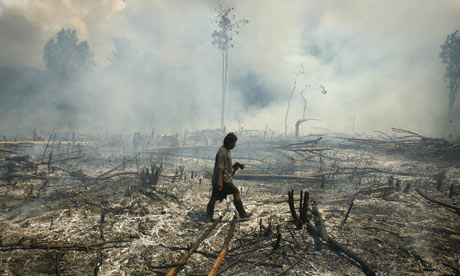
It was in the theatre for one of these documentaries that  I experienced a shift in my attitude toward climate change.  I've been reading so much about how we have to act now, time is limited and that we’re dangerously close to a point of no return, and yet… we’re still so far behind. We’re debating the cause rather than investing in solutions. We’re denying evidence provided by people who devote their life to finding answers and instead listening to white men in shiny suits tell us what we want to hear. I've been acknowledged for my “unbridled optimism” in many settings- whether at work or around friends, but the fate of the Earth is one scenario where I can’t realistically see the glass half full. I see deforestation, greed, pollution, globalization and overpopulation. And being stepped on by all those things are a little team of whole-hearted environmentalists being called “watermelons” –green on the outside, red on the inside.

I’m consistently frustrated to see groups of healthy, empowered communities taking action against corporate greed getting combated by overweight men with self-appointed authority. What are these WASPs trying to protect? Chemically-laden frappacinos? Petroleum-dependent automobiles? The “freedom” to purchase a phone that is designed to wear out in less than two years? Surely these things are worth fighting for…or else we’d all be growing organic vegetables in our yard, walking our kids to school and sharing stories under the stars instead of sitting on the couch staring at our electric light box. How dare these hippy environmentalists try to make us convert to using renewable resources!

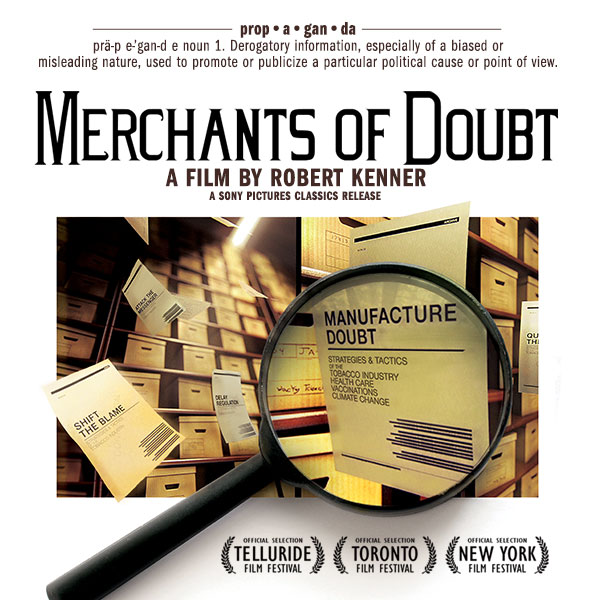
Satire aside, I decided right there, while watching Merchants of Doubt that it’s about time for us environmentalists to shift our attitude toward climate change. No, I don’t think we should throw in the towel and use up all the resources we can before we annihilate ourselves. I think we should start preparing for impending disaster.
Google Search: Environmental Apocalypse

What I've concluded from This Changes Everything and Merchants of Doubt is that people like me are reading these things and thinking, “hell yeah!” but those deniers they highlight are just getting stronger. In both pieces, they bring up the fact that people don’t want to feel that their ideals are being threatened, or be regulated by the government. The more I thought about that last one, I started to think of it like managing traffic. In a small town, you can have stop signs to regulate traffic flow. As an area gets more congested, just as our earth is getting more damaged, imbalanced and polluted, you have to put in traffic lights. Everyone is taught what a traffic light means, and everyone is expected to follow the rules. You don’t have to, but you will risk getting a ticket, or worse…injuring yourself or someone innocent. These are basic regulations put in place to keep us all safe, even though following traffic lights may make us feel like lab rats. If we chose not to abide by traffic lights, a huge accident could occur, and that’s when fire departments, police departments and the like have to come in. Similarly, if we continue to neglect the damage we’re doing…we’re all going to be living in FEMA camps and eating bland fortified foods. All because we’re standing on the street arguing whether or not to put in a traffic light.

I have often contemplated where to focus my energies toward our Earth. Is it really going to make a difference for me to bring my own water bottles, conserve energy around the house and bike around town, if millions of other people aren't doing that. Should I invest in educating those millions? (Well, that’s what I’m trying to do with this blog, and being an environmental educator, but as I’ve probably mentioned before, it’s a depressingly slow endeavor). What’s the use when there are still losing swaths of forests the size of Panama annually, and influencing extinction rates 1,000 fold. But there’s another idea. Something I’ve thought before but haven’t been inspired to act upon until now. I can invest in learning as much as I can about how to survive without these systems we have become dependent upon, like electricity, and coal, and gasoline.

I walked out of the theatre with a new sense of importance, and a slight sense of guilt. I had previously made a goal to have at least an annual salary worth of money in the bank by the end of the year—a goal that I’m quite close to reaching. But what use is that money if we don’t have those systems? I’ve hesitated because of the ‘post-acopolyptic crazy’ feel of it, but my big revelation is that by spending that money on learning to grow food, to utilize invasive, and use a weapon, and play drums (you never know), I’m not only building skills for a potential apocalypse, I’m building my community and myself.